Afriques

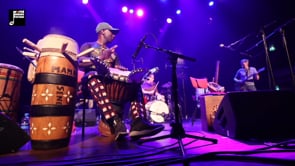
Richard Rijnvos composes with Grand Atlas a series of orchestral works in which he crosses the continents of our planet crisscrossing with musical impressions. Afrique - his tour of Afrkia - composed for the six percussionists of Slagwerk Den Haag and the Residentie Orkest. It sounds during the festive honeymoon in which the fresh Hague concert hall Amare is inaugurated.
In zijn nieuwe orkestwerk brengt Rijnvos een bezoekt aan Egypte, Oeganda, Botswana, Kameroen en Senegal. Op zijn website licht hij het stuk uitgebreid toe: “Afrique is the fourth part of Grand Atlas, a cycle in which each of the seven world continents is depicted in an orchestral composition.Our clockwise journey begins in North Africa, more precisely, the heart of Egypt. On our way to the historic monuments, temples and tombs near Karnak and Luxor, we hear snatches of native music coming from afar. Approaching the village of El-Tod, we clearly distinguish the characteristic sound of the mizmar, an extremely loud double-reed woodwind instrument. It’s a sort of Arabic oboe, which, due to its trumpet-like bell, easily manages the kind of volume we normally expect from brass. Two players improvise in a quasi-unison manner, whilst a third persists in sustaining what seems to be a never-ending, piercing, yet seducing drone. Traditional drums, such as darbuka, duff and duhulla provide a stirring accompaniment.We descend by boat down the Nile, all the way to Lake Victoria in Uganda, East Africa. The hospitable locals of Nakibembe, a small village in Busoga, treat us to an evening of their indigenous music. The central instrument is the embaire, a xylophone about 2.5 metres long, played by six people, seated three on each side. It has gigantic keys made from ensambiya wood, and is placed on a huge hole in the ground for resonance purposes. The music is lively and cheerful, with untrained voices singing along every now and then.Our travels continue via the east coast, in the direction of Southern Africa, to Botswana, where we meet the Balete people. In these regions, the focus is not so much on percussion. Instead, the locals play reed flutes, so-called ditlhaka, and they tend to gather in ensembles that incorporate dozens of participants, performing traditional dances, which can last for hours. The common practice is for men to play a variety of different-sized flutes, while dancing counter-clockwise in a circle, surrounded by women and young girls clapping.Travelling back north via the west coast, to Central Africa, we cross the rainforest of Cameroon, home of the Baka people. Their music is mainly vocal, displaying a striking polyphonic sophistication. Based on repetitive melodic fragments, with little variation, but lots of improvisation, they dance, sing and yodel as part of healing rituals, initiation rituals, funerals, but also for sheer entertainment.Our voyage ends in Senegal, West Africa, where the Wolof people preserve the Sabar drumming tradition. Among its most renowned pioneers was maestro Doudou N'Diaye Rose (1930-2015), and it is in his memory we finish with an orchestral remix of his legendary and utterly exhilarating “Rose Rhythm”.
Programma
Richard Rijnvos Afrique (wereldpremière)Felix Mendelssohn Symfonie nr. 3 ‘Schotse’Residentie OrkestSlagwerk Den HaagAntony Hermus dirigent
🔊 Beluister het concert op Radio 4
Lees de recensie van Joep Stapel in de NRC
Lees het Volkskrant-interview met Richard Rijnvos